As a marketing leader in a B2B SaaS company, you are responsible for leading your team to success in a fast-paced and constantly evolving industry. In the past, we looked at leadership skills as a linear checklist. However, the modern landscape requires a blend of qualities that intermingle and amplify one another.
To be successful today, you need to understand how these skills intersect to enable dynamic reactions, deep analysis, and genuine human connection. Here’s how I’ve seen top leadership qualities actually function in the wild.
The Partnership of Strategy and Agility
Strategic thinking is often touted as the ability to see the big picture, but a strategy in a vacuum is useless. In B2B SaaS, strategic thinking must be tightly coupled with agility.
It’s not enough to simply map out the variables and create a long-term vision. Strategic thinking combined with agility enables the marketer to not only think of the variables but have the capability to dynamically react and pivot as circumstances change.
We all know the feeling. Results aren’t as expected or new data comes in that fundamentally changes the original theory. If you are rigid in your strategy, you fail. If you are agile without strategy, you are chaotic. You need both to recognize when a hypothesis has been disproven and instantly shift the ship to a new course.
Communication: Navigating the Hard Truths
Communication plays a big part in conveying the strategy, but its most critical function is navigating the ship when it needs to change. Change is hard to navigate, especially with a bigger team.
People generally don’t like having to change what they have already built or created. They don’t like to face the facts that the results were not what was expected. There is a natural tendency to hide poor performance, not address it at all, or skip the analysis phase entirely to keep pushing out new work.
Effective communication as a leader means having the difficult conversations that stop this cycle. It’s about creating a space where we can look back, analyze what happened without blame, and stop the “blind production” of new campaigns just to feel busy.
Deep Analytics and the Measurement Plan
This need for honest communication leads directly to analytic skill. To communicate truth, you need to understand how things work on a deep level so you know how to measure success and value.
This goes beyond glancing at a dashboard. You need a measurement plan and the discipline to follow up and analyze data, even after months have gone by. This is difficult because marketing is always under pressure to keep pushing and pushing. The more you output, the more measurement and analysis needs to be done.
If you are not analyzing the long-tail impact of your work, you are just guessing.
Technology, Creativity, and the AI Lever
The demand for high output and deep analysis leads into why a passion for technology and creativity play a big role. Marketers need to leverage every possible new tool, new process, and new idea in order to compete.
It can be risky because some new technologies don’t play out. However, others such as LLMs and AI have become critical in achieving what is normally not possible: a combination of more output while leveling up quality.
Analyzing campaigns has become much more efficient with these tools. Tasks that used to be time-sinks are now streamlined, specifically when conducting advanced analysis such as:
- Multi-touch attribution modeling: Understanding which distinct touchpoints contributed to a closed-won deal over a 6-month sales cycle.
- Cohort retention analysis: determining if the leads generated from a specific campaign actually stay with the product long-term.
The Growth Machine: Collaboration and Persuasion
Collaboration, work ethic, and persuasion are very closely tied together as a marketing leader. You cannot operate in a silo. You need to work cross-departmentally because marketers support the entire growth machine at SaaS.
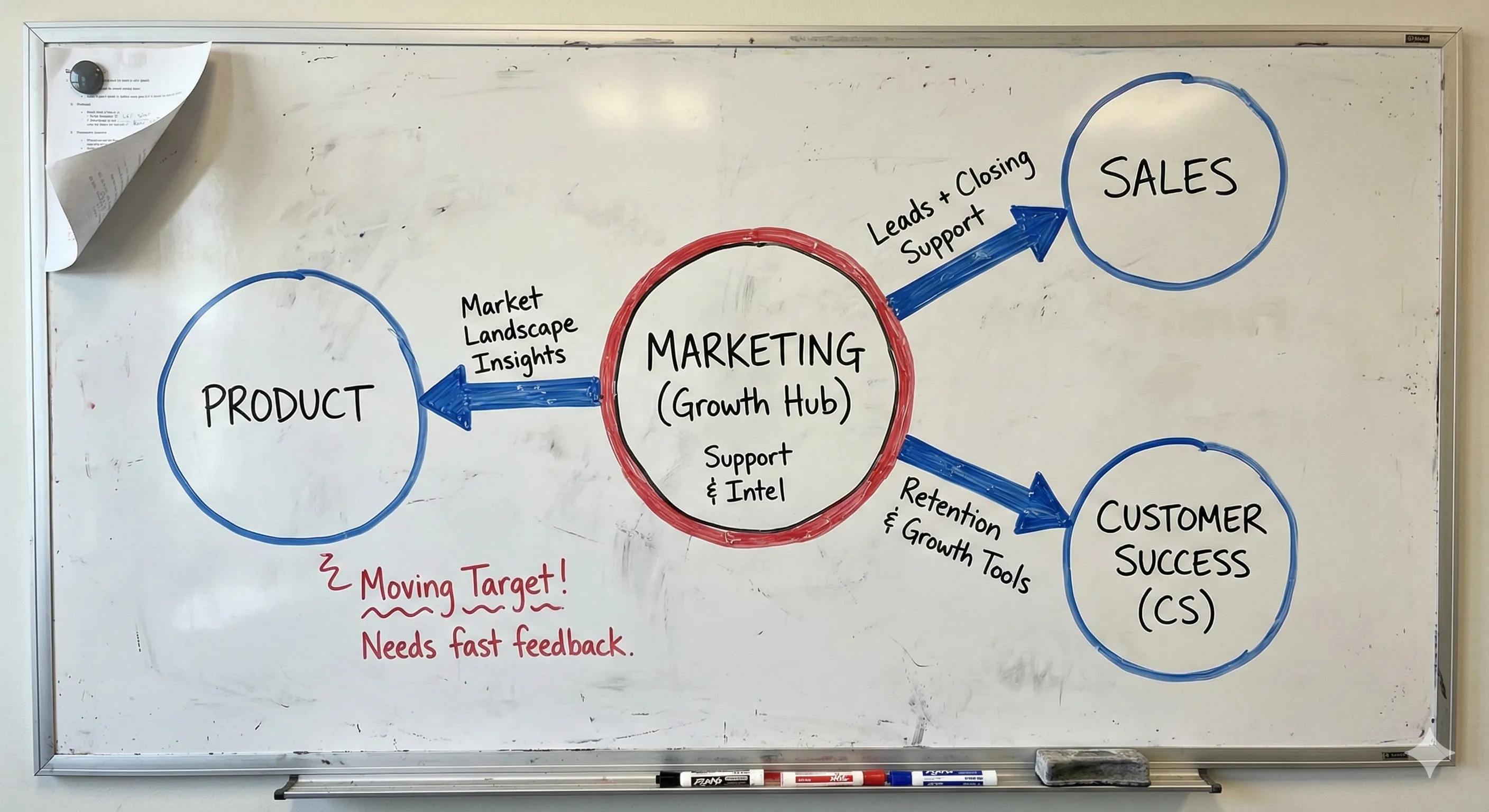
We are responsible for getting new leads and qualifying them. We support sales to close them. We support CS to keep and grow those accounts. Crucially, we support product by giving them insight into how the landscape is changing.
Product-market fit is a moving target. You can easily fall out of it, especially now with how fast things move and change with AI. You need the persuasion skills to convince other departments of these market shifts and the collaboration skills to help them adjust.
Empathetic Leadership
Empathy is foundational to leadership. You are only as good as your team. Your team is made of people, and people have many things happening in their lives. As a leader, you need to inspire, motivate, and extract as much potential out of them, even when the chips are down.
When hard times are among us, or when a campaign flops, or when the market shifts unexpectedly, it’s Empathetic Leadership that keeps the team moving forward. It’s the ability to say, “We missed the mark, but I know we can fix it,” and actually mean it.